Too dry or too moist – That is the question.

Smoking a good old joint is a timeless ritual—but vaporizing has many benefits. For starters, vaporizing is healthier than smoking. Vaporizing doesn’t combust your herb, so you’re inhaling fewer of the harmful toxins present in smoke.

Vaping also makes for a purer cannabis experience. The smoke from your joint only contains around 10% of cannabinoids (the “good stuff”) in cannabis—the rest is a combination of unhealthy byproducts. Vapor clouds contain as much as 95% of the goodies from your weed. This makes them very pure and a lot more potent.

But know that when using a vaporizer, the right temperature setting can make all the difference! And the right status of cannabis also affects a lot.

Unlike when you use a bong or smoke a joint, bone dry cannabis can still be a delight in a cannabis vaporizer. However, because it is so dry, it will vaporize much faster – if it is too hot you run the risk of flash boiling the active ingredients, eliminating taste and flavor.

As it is largely going to depend on the situation and cannabis strain you are using, there is no definitive guide to how to properly vaporize particularly dry weed; but as a rule of thumb you will want to reduce the temperature from your norm, going lower the drier it is.

Conversely, if your bud is fresh, then it may be very high in moisture. As a result, it can sometimes be hard to get cannabinoids out. To deal with this, it is recommended to do what‘s called a flavonoid run. By putting the cannabis vaporizer at a lower temperature (around 138 – 148 °C.), it is possible to gain a bag of flavonoid vapor whilst slowly drying out your cannabis a bit. After this run, your cannabis should be dry enough to vaporize efficiently at THC and other cannabinoid temperatures.

Vaping Medicinal Cannabis

Cannabis flower has traditionally been placed in to rolling paper alongside tobacco and smoked, however there are a growing number of studies and research into the benefits of vaping medicinal cannabis rather than smoking.

Vaporising on the other hand involves heating the cannabis flower to a temperature that releases the active chemical compounds in the form of vapour which is then inhaled using an electronic device.

So whilst the most obvious reason to choose a vaporiser is your health, there are other additional benefits from using a vaporiser;

Flavour and Aroma

Vaporising releases the cannabis flower terpenes and flavonoids better than smoking due to the lower temperature used. These flavours and aromas are different strain to strain and are believed to have an ‘entourage effect’ with beneficial properties such as anti-inflammatory and antioxidants.

Temperature

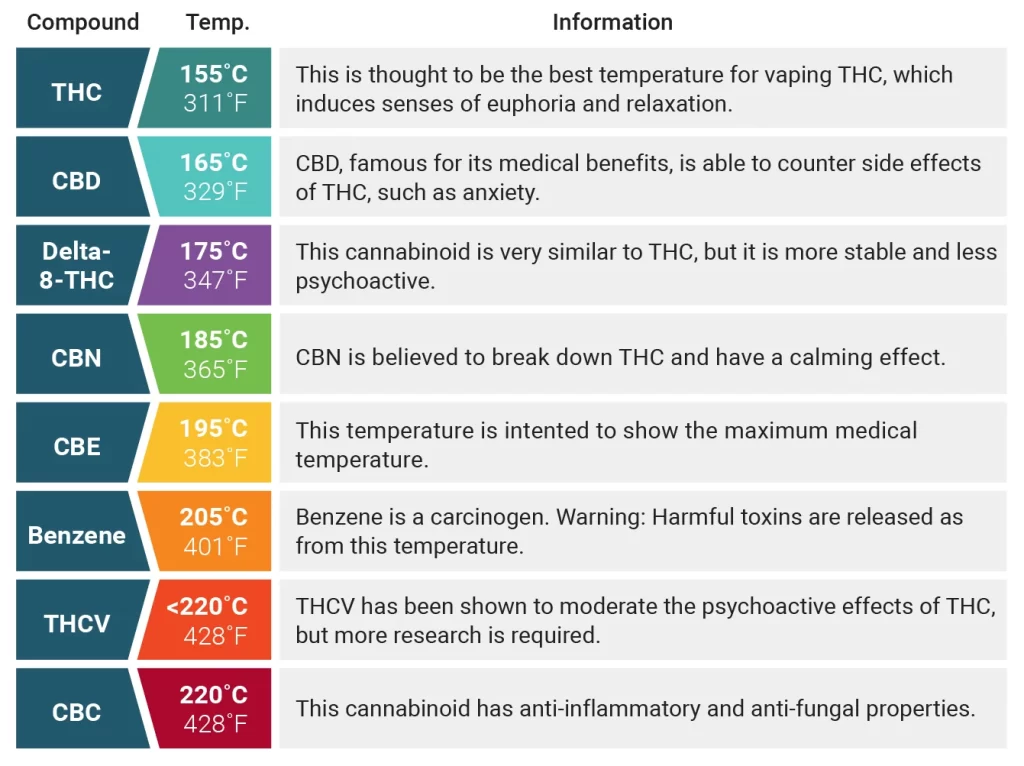
Vaporisers allow precise temperature control, which can be beneficial for maximizing the therapeutic effects of cannabis. Different cannabinoids and terpenes vaporize at different temperatures, and by adjusting the temperature, you can target specific compounds. Smoking, however, can reach higher temperatures and may cause some compounds to degrade or burn off.

Efficiency and dosage control

Vaporising can be more efficient than smoking as it can extract a larger proportion of cannabinoids and terpenes from the cannabis. Often when smoked Cannabis is lost due to side-stream so less of the cannabis enters your lungs. Additionally, vaporisers allow for better control over the dosage since you can adjust the temperature and inhale smaller, more controlled amounts of vapor.

Convenience and portability

Vaporisers come in various forms, including portable options such as handheld devices which are more discrete and convenient than smoking and so can be used in a wide variety of settings.

Social acceptance

Smoking cannabis may not be socially acceptable in certain settings due to the smell and the association with smoking. Vaporising can be less intrusive in terms of odour, making it more socially acceptable in some situations.

Vaping medicinal cannabis involves:

  • Grinding the flower; so, the flower can be heated and vaporised up evenly.
  • Pack the ground flower into the chamber, usually between 0.25g to 0.5g, depending on the dosage instructions from the prescriber, then seal the chamber.
  • Adjust the temperature setting; select the desired temperature setting based on the boiling point of the desired terpenes and their beneficial properties.
  • Let the vaporiser warm up to the desired temperature, this may take a few minutes.
  • Inhale through the mouthpiece, place your lips around the mouthpiece and inhale, holding the vape in your lungs for 5-10 seconds then slowly exhale.
  • Once you are done throw away the flower once you can no longer taste it anymore.

These instructions may vary between the devices, please check your instruction manual for specific instructions relating to your vaporiser.

There are some drawbacks to vaping medicinal cannabis, however these can be managed with additional preparation and learning how to use the device effectively.

Preparation

Cannabis flower will need to be prepared for use in a vaporiser, usually by grinding the flower to create a larger surface area from which the heating is more effective at extracting the chemical compounds. This will require the purchase of a grinder alongside the device, but these devices are inexpensive.

Device familiarisation

Using a vaporiser initially will take some learning, but this is fairly simple and users become proficient very quickly and learn over time to master the use of these to get the best from their medicinal cannabis.

Battery Life

Ensuring your device is charged or you have access to mains power to use your vaporiser might take some time getting used to, but as with other portable handheld electronic devices, they have good battery life and patients.

Maintenance

Vaporisers require some regular maintenance to keep their performance optimal, mainly through cleaning and the replacement of parts if they become damaged or worn out, but this is simple to perform and takes little time.

Medicinal Cannabis and Menopause

Are you experiencing menopause?

If it has been 12 months since your last period, and have no other health issues that may affect your cycle, you may be experiencing menopause. It usually begins anytime between someone’s mid-forties to mid-fifties and lasts for several years.

Menopause is caused by a massive change in estrogen levels in a woman’s body. Weight gain may now happen more easily, and bone and heart health can be affected. Some women may not experience any symptoms of this change, but others may experience symptoms like hot flashes, sleep troubles, moodiness and irritability, painful sex or depression.

What can happen to a woman’s body post-menopause?

Once estrogen levels have decreased, women may now experience weight gain due to the body now storing more fat. There may be a higher risk of developing osteoporosis (weak bones) and heart disease because of these lower estrogen levels.

How can CBD help with menopause?

Sleep
Many women going through menopause report having trouble getting a good night’s sleep. Whether it’s frequent night wakes, insomnia, or waking early, reduced sleep can add up and make day-to-day life difficult. Researchers have found that CBD may help decrease sleep troubles, improve the quality of sleep, and help people fall asleep faster. Research has indicated higher doses of CBD may have a sedative effect, too.

Hot flushes
Hot flushes are a common occurrence for women during and after menopause. It is believed they are related to the changing estrogen levels in the body. Hot flushes are usually experienced in the upper part of the body — a woman may find her skin is flushed, and she experiences heavy sweating and chills. These hot flushes could last a few seconds or several minutes. THC can mimic some aspects of anandamide, an endocannabinoid that helps regulate body temperature — but medicinal cannabis may help manage anxiety, which can be a trigger for a hot flush.

Anxiety, depression and mood issues
During menopause, there is an increased risk of depression and anxiety. This may be due to menopause itself or the symptoms that come along with this body change.

Animal studies have found medicinal cannabis may help manage depression and anxiety, nevertheless, there is currently no research into whether this also translates to humans. There are some case studies available and we have seen firsthand in the clinic how medicinal cannabis may help those facing mental health issues, however.

Muscle aches and joint pain
Women can develop menopause-related arthritis (pain in joints) due to increased inflammation from the decreased estrogen levels. A 2015 animal study found that topical CBD may help reduce inflammation, and concluded that topical CBD may help with inflammation.

What type of CBD is best for menopause symptoms?
If you’re looking for fast relief from symptoms such as anxiety or sleeping troubles, CBD oil taken beneath the tongue is the best option. Edibles are another easy and discreet option that may take a little longer than CBD oil but are just as effective. For joint pain and muscle aches, topical CBD will likely be the best treatment option for you. One of our qualified doctors will be able to guide you to the best product option depending on your menopause symptoms.

What does the research say?
Research completed in June 2022 showed that mice with decreased estrogen levels responded positively to being treated with medicinal cannabis. Some women experience weight gain post-menopause, and after being treated with cannabis, the mice were better able to dispose of glucose from their bloodstream and burned more energy. Their bone density also improved, which could help women avoid developing brittle bones (osteoporosis), and they had less gut inflammation and better levels of healthy gut bacteria.

Research into how medicinal cannabis can help with menopause specifically is ongoing, but currently still very limited due to medicinal cannabis only recently being legalised. There are no current human studies relating to cannabis and menopause, but we look forward to research coming out in the future that addresses woman’s health.

If you’re struggling with menopause symptoms and are looking for relief, medicinal cannabis may be an option for you. – fenixvapes.co.nz

What You Need to Know about Using Medical Cannabis Flower in a Vaporiser in NZ

Medicinal cannabis has been available on prescription in NZ since 2018, and since then an ever-growing number of patients have been able to access these medicines. We recently told you that the very first medical cannabis flower was verified as meeting the quality standards in New Zealand but, at the time, this was only for use when brewed as a tea. Well, good news! Medicinal cannabis flower has now also been verified for inhalation via a vaporiser.

New Zealand is following through with its plan to roll out the country’s medicinal cannabis program, and the industry has evolved significantly since the initial law change. There is now a wider variety of medical cannabis products available for doctors to prescribe for a range of complex health conditions.

Depending on their condition and medical needs, patients may now be prescribed medicinal cannabis in the form of oils, as well as medical cannabis flower for tea and vaporising.

How does a vaporiser work?

Vaporiser devices heat the inserted cannabis flower to a temperature hot enough to evaporate the cannabinoid compounds. This allows the user to inhale the products and the effects are felt within a couple of minutes. A quality vaporiser will heat the cannabis flower to the correct temperature (without burning) to achieve the greatest effect.

Is vaping better than smoking?

Vaporising cannabis may be a great option for patients needing quick, short-term symptom relief. Although only a small number of studies have been conducted on vaporising cannabis, these studies have shown that it is healthier compared to smoking the flower.

One study suggested that frequent cannabis users who reported respiratory problems after smoking the substance, described that their symptoms improved after just a month of switching to a vaporiser. Another study tested the difference in compounds that is inhaled between a vaporiser and smoking. The vapor produced from a high-quality medically approved vaporiser mostly contained therapeutic compounds. In comparison, cannabis smoke contained some toxic compounds, specifically pyrene and other polynuclear aromatic hydrocarbons (PAHs).

Another benefit of vaporising cannabis is that it is far more efficient and uses less flower compared to smoking. Only a small percentage of the plant’s medicinal compounds are made available when a user smokes cannabis as a lot of the cannabinoids are burnt up when the flower is lit on fire. In contrast, a high-quality vaporiser typically makes over 50% of the flower’s medicinal compounds available to the user. Users can also vape the same batch of flower more than once and at varying temperatures. – www.fenixvapes.co.nz